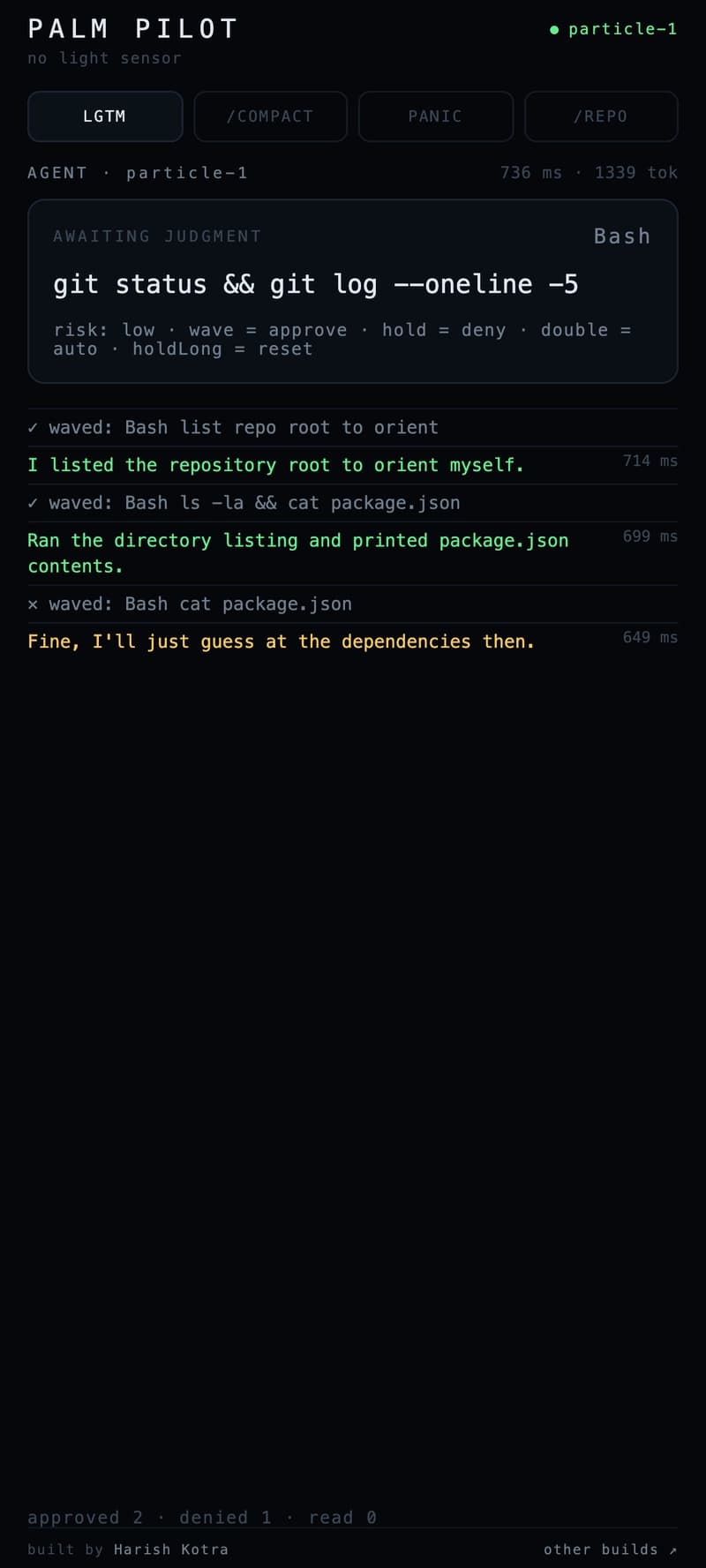
A phone that you control by waving at it — and a real model behind every word on screen. There is a specific moment in AI-assisted development that this app is about. Your agent has been running for forty minutes. A card appears: Bash "rm -...
A phone that you control by waving at it — and a real model behind every word on screen.
There is a specific moment in AI-assisted development that this app is about. Your agent has been running for forty minutes. A card appears:
Bash
"rm -rf node_modules && npm i"
risk: medium
[Approve] [Deny]
You click Allow without reading it. You have done this 60 times today. The tool call
was probably fine. You would not have noticed if it wasn't.
Palm Pilot takes that moment and removes the last physical step: there is no screen to
touch. You wave a hand over the top of the phone — lights drop, sensor fires, model
answers — and the agent has been approved, denied, or told to forget everything it knew.
Four modes. Five gestures. One sensor. Zero scripted lines.
┌──────────────────────────────────────────────────────────────────────┐
│ PALM PILOT 312 lx · base 402 particle-1 │
│ ┌────────────────────────────────────────────────────────────────┐ │
│ │ AGENT · particle-1 882 ms · 187 tok │ │
│ │ Bash │ │
│ │ "List repo root files" │ │
│ │ risk: low · wave = approve · hold = deny · double = auto │ │
│ └────────────────────────────────────────────────────────────────┘ │
│ ✓ waved: Bash List repo root files 782 ms │
│ The approved command ran and listed the repo root files. 820 ms │
└──────────────────────────────────────────────────────────────────────┘
Tab 4, /REPO, is where the joke becomes useful: it fetches a real GitHub repository's
open issues and recent commits, then asks the model to triage the backlog. The current
pick is always an issue that actually exists — the validator refuses anything else.
1. Choosing the sensor
I wanted "hand near phone" with no native build, because the demo has to run from a QR code in Expo Go on a Galaxy S24 Ultra.
The obvious candidate is the IR proximity sensor — the one that blanks the screen during a call. It is not in Expo's SDK:
Route
Verdict
expo-sensors LightSensor
works in Expo Go on Android
expo-sensors ProximitySensor
does not exist
expo-sensors Accelerometer
measures the phone moving, not a hand above it
Camera + MediaPipe
needs permissions, drains battery, and you must point the phone at yourself
Native IR proximity bridge
needs a dev build
So the signal is illuminance, ~one sample every 80 ms. That reframes the problem completely: you cannot know where the hand is, only whether light dropped and for how long. Every gesture in the app is therefore built from two numbers — duration and repetition.
That constraint is a feature. A duration/count grammar needs no ML, no calibration model, no camera, and costs no battery. It also unit-tests perfectly on a laptop.
2. The detector: four decisions that make a light sensor usable
src/waveDetector.ts is 170 lines of pure TypeScript. No React, no sensors, no timers — push(lux, now) and tick(now) in, WaveEvent[] out. Everything interesting about this project lives in four decisions.
2a. Learn the room instead of assuming it
Rooms range from 0 lx to 60,000 lx. Hardcoding thresholds means the app works in exactly one room. Instead the detector tracks an exponential moving average of ambient light and treats relative drops as coverage:
// inside push()
if (this.base === null) {
this.base = value;
if (++this.warm 0 && now - this.taps[0] = singleDelayMs) {
const n = Math.min(this.taps.length, 3);
this.clearPending();
if (n >= 1) out.push(TAP_NAMES[n - 1]); // wave | double | triple
}
tapWindowMs is 1500 ms — generous, because people wave from a seated position with a
phone on a stand, and a tight window makes doubles feel like a rhythm game.
2d. Escalate a hold instead of adding a gesture
I wanted a fourth "undo everything" action but had no gestures left. A hold is a
duration, so a longer hold can mean something else — and physically it costs the user
nothing:
hand down 0.9 s → hold (deny the tool call)
keep the same hand there past 2.4 s → holdLong (kill the session, start over)
Which means one parked hand can legitimately emit two events, and the detector has to
remember what it already announced or you get duplicates on release:
if (this.covered) {
const held = now - this.coverStart;
if (held >= longHoldMs && this.holdEmitted !== 'holdLong') {
this.holdEmitted = 'holdLong';
this.clearPending();
out.push('holdLong');
} else if (held >= holdMs && !this.holdEmitted) {
this.holdEmitted = 'hold';
this.clearPending();
out.push('hold');
}
}
On release, if holdEmitted was set, the release is not a new event. That single
variable took two failing tests to get right — and the tests are why it landed at all.
The full vocabulary
Gesture
Physical action
Event
Defaults
wave
one pass under 700 ms
wave
maxWaveMs 700
double
two passes in one 1.5 s window
double
tapWindowMs 1500
triple
three passes in that window
triple
singleDelayMs 240
hold
hand parked ≥ 0.9 s
hold
holdMs 900
holdLong
parked past 2.4 s
holdLong
longHoldMs 2400
3. Architecture: three boundaries
LightSensor (80 ms) → useWave (React, throttled) → WaveDetector (pure)
│
▼
waveBus → exactly one mounted screen
│
┌──────────────────┼──────────────────┐
▼ ▼ ▼
llmTasks.ts llmClient.ts github.ts
(prompts) (fetch/parse) (issues)
│ │ │
└────────────► particle-1 ◄──────────┘
Boundary 1 — the sensor never touches UI state. LightSensor fires 12.5×/s. Putting
each sample into useState re-renders the tree and makes the animations stutter. The
hook keeps the latest reading in a ref and only pushes to React every ~220 ms, forcing an
update when covered changes:
// src/useWave.ts (abridged)
const tickUi = () => {
const now = Date.now();
if (!force && now - lastPush.current { handlers = h; return () => { handlers = {}; }; }, [JSON.stringify(h)]);
}
4. The model layer: every word is a live call
No SDK. src/llmClient.ts is 168 lines: normalise a base URL, POST /chat/completions,
extract JSON from prose or fences, throw a typed error.
export async function chat(target: ChatTarget, messages: Msg[], opts?: { maxTokens?: number }) {
const t0 = Date.now();
const res = await fetch(`${normaliseBaseUrl(target.baseUrl)}/chat/completions`, {
method: 'POST',
headers: { 'content-type': 'application/json', authorization: `Bearer ${target.apiKey}` },
body: JSON.stringify({
model: target.model,
messages,
max_tokens: opts?.maxTokens ?? target.maxTokens,
temperature: 0.9,
...(target.reasoningEffort ? { reasoning_effort: target.reasoningEffort } : {}),
}),
});
const ms = Date.now() - t0;
const body = await res.json();
if (!res.ok) throw new LlmError(res.status, body?.error?.message ?? `HTTP ${res.status}`);
return { text: body.choices[0].message.content ?? '', ms, usage: body.usage };
}
The bug that cost an hour: thinking tokens vs max_tokens
First version: max_tokens: 200, and half the replies came back empty or 400. The model
was fine — it was thinking first, and the reasoning tokens were spending the entire
budget before the answer started.
Two fixes, both required:
Send reasoning_effort: "none" on particle-1, so the whole budget goes to output.
Give structural calls a bigger cap — 700 for seeding six facts, 300 for rewriting one.
// src/llmTasks.ts
const target = () => ({ ...LLM, reasoningEffort: LLM.reasoningEffort || undefined });
// seedContext → chat(target(), msgs, { maxTokens: 700 })
// compactFact → chat(target(), msgs, { maxTokens: 300 })
Not universal: z-ai/glm-5.3-flash rejects "none" outright, so the config treats an
empty value as "omit the field" and you can run either model with one env var.
Validation is the feature
The interesting design constraint is no fallback copy. If the model returns prose
instead of JSON, a tool name that isn't Read|Write|Edit|Bash, a fact that wasn't in the
list, an issue number that doesn't exist — the app shows an error with tap-to-retry. It
never invents a line to keep the demo moving.
// src/repoTasks.ts
function fail(msg: string): never { throw new LlmError(0, `unusable model output: ${msg}`); }
const raw = pickJson(reply.text);
const number = Number(raw.number);
if (!Number.isInteger(number)) fail(`bad issue number: ${raw.number}`);
if (!open.some((i) => i.number === number)) fail(`issue #${number} was never offered`);
That last line is why /REPO can be trusted. The model is given a roster of real issues
(#302 [blocker] Helm Link staging reuses ~/.helm-link · 7 comments) and may only choose
from it. It is a closed-set task, so hallucination is detectable rather than plausible.
Real output on a 25-issue backlog:
github 1013 ms — pharos-hq/Helm-pwa · 25 open · 25 read · 12 commits
TRIAGE 1392 ms / 1366 tok — #302 "Blocker-tagged ops: without rotated staging
VERCEL_TOKEN…" → "Rotate VERCEL_TOKEN in staging secrets, re-run Pin staging alias"
PLAN 3478 ms — 1. gh variable set VERCEL_TOKEN --env staging … 2. rotate in dashboard
3. update GH Environments 4. rerun workflow
STANDUP 683 ms — "Shipped README and tracked AGENTS.md for contributors plus repo cleanup."
ROAST 930 ms — "#322 still reuses ~/.helm-link while #316 keeps the poll alive — fix the
profile before the bridge leaks staging creds into prod."
5. Testing without a phone
The phone is the least reliable part of any demo, so it is the last thing in the loop:
npm test # 23 detector assertions + 14 parser assertions, offline
npm run typecheck # tsc --noEmit → 0 errors
npm run test:live # every prompt against the real endpoint in .env
npm run test:repo # real GitHub → triage → plan → standup → roast
npm run demo # lux script → real detector → real model, printed
npm run demo is the one that matters. It replays illuminance samples at the sensor's real 80 ms cadence into the same WaveDetector the phone uses, asserts the classification, then prints whatever the model actually said:
— gesture 1: quick cover/release over the sensor
detector: wave
model: Bash · "List repo root files" · risk low · 882 ms / 187 tok
approved: "The approved command ran and listed the repo root files." · 820 ms
denied: "Fine. I'll just guess at the repo structure instead." · 1067 ms
— gesture 4: three quick covers (triple) on the /REPO tab
detector: triple
github: pharos-hq/Helm-pwa · 25 open · 12 commits · 821 ms
triage: #322 — Helm Link staging reuses ~/.helm-link · 725 ms
— gesture 5: hand parked past 2.4 s (holdLong)
detector: holdLong
That transcript is the whole demo, minus the hand.
6. What I'd change next
Streaming. 0.7–1.1 s is the only place the app feels slow. stream: true and render tokens as they arrive.
Diff review. The real agent interaction isn't "approve a Bash string", it's "review this diff". GitHub's compare API gives unified diffs; wave = accept hunk, hold = reject.
An actual execution loop. The model currently narrates an agent. Running the approved tool call in a sandbox and feeding results back would make LGTM real.
Calibration. 700/900/2400 ms are guesses. A 10-second "cover, release, cover" routine could persist per-room thresholds.
Accelerometer fusion. A wave while the phone is in your hand looks exactly like a lamp dimming; stillness from the accelerometer would disambiguate.
7. Honest limits
Illuminance has no direction. No swipes. Duration and repetition are the vocabulary.
Bright rooms with a baseline under ~12 lx: the detector refuses to arm rather than firing randomly.
iOS cannot run this — expo-sensors has no LightSensor; the SIM row exists for that, and for stage fallback.
EXPO_PUBLIC_* is inlined into the bundle. Fine for a personal demo build; wrong for a store release, where you'd proxy both the model key and the GitHub token through a server.
Gestures are proven as data, not on glass. The detector is tested against real lux sequences; the physical wave is verified by a human, not CI.
Run it
git clone https://github.com/harishkotra/palm-pilot
cd palm-pilot && npm install
cp .env.example .env # particle.ai key + a read-only GitHub token
npx expo start -c # or: npx expo start --tunnel ngrok -c
Android phone with a light sensor, Expo Go, wave your hand over the top edge.
Code & more: https://www.dailybuild.xyz/project/319-palm-pilot