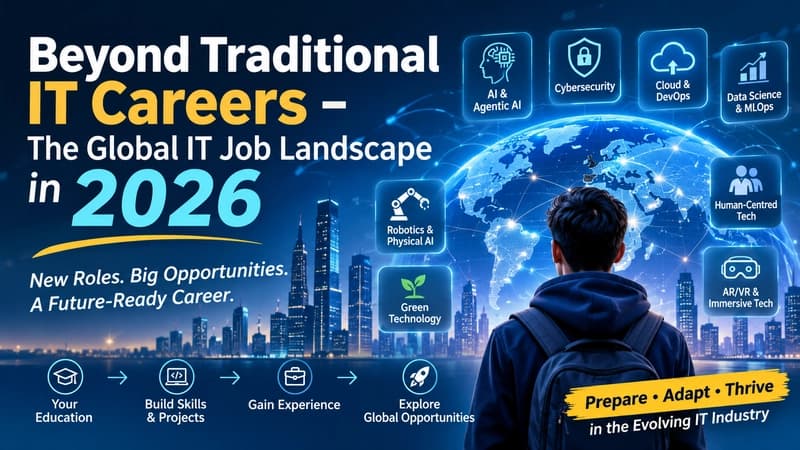
The Future of Technology, Career Opportunities, Skills and Challenges The Information Technology industry is evolving faster than ever before. Artificial Intelligence (AI), automation, robotics, cybersecurity, cloud computing and other eme...
The Future of Technology, Career Opportunities, Skills and Challenges
The Information Technology industry is evolving faster than ever before. Artificial Intelligence (AI), automation, robotics, cybersecurity, cloud computing and other emerging technologies are transforming not only how businesses operate but also the types of professionals they need.
In 2026, the global IT industry is moving beyond traditional career paths. While software developers, network engineers and database administrators remain essential, new specialised roles are emerging as organisations adopt intelligent technologies and automated systems.
According to the World Economic Forum's Future of Jobs Report 2025, AI and big data, networks and cybersecurity, and technological literacy are among the fastest-growing skills expected to shape the global workforce by 2030.
So, what new career opportunities are emerging? What should university students learn to enter these fields? And what challenges should future IT professionals prepare for?
Let's explore.
1. Emerging IT Job Categories in 2026
The following categories include genuinely emerging professions as well as established occupations evolving through new technologies.
1.1 Artificial Intelligence and Agentic AI
The rapid development of generative AI and autonomous AI systems is creating new opportunities.
Some emerging roles include:
AI Agent Engineer
Agentic AI Architect
Generative AI Engineer
AI Workflow Automation Engineer
AI Evaluation Engineer
AI Safety Engineer
AI Governance Specialist
AI Security Engineer
These professionals develop, manage, evaluate and secure intelligent systems capable of performing increasingly complex tasks.
1.2 Advanced Software Engineering
AI-assisted development and modern software architectures are changing traditional software engineering.
Emerging roles include:
Forward-Deployed Engineer
AI Application Engineer
AI Integration Engineer
Multi-Agent Systems Developer
AI-Assisted Software Developer
Low-Code/No-Code Solutions Architect
The focus is gradually expanding beyond writing code towards designing intelligent applications, integrating systems and solving real-world business problems.
1.3 Cybersecurity and Digital Protection
As digital threats become more sophisticated, organisations require professionals who can protect their systems and information.
Career opportunities include:
AI Security Engineer
AI Red Team Specialist
Cloud Security Engineer
Threat Intelligence Analyst
Digital Identity Engineer
DevSecOps Engineer
Deepfake Detection Specialist
** 1.4 Data Science and Intelligent Data Engineering**
AI systems depend on reliable data, creating opportunities in data management, machine learning and model operations.
Some relevant roles include:
Synthetic Data Engineer
AI Data Engineer
LLM Data Specialist
MLOps Engineer
LLMOps Engineer
AI Research Engineer
Computer Vision Engineer
1.5 Robotics and Physical AI
AI is expanding beyond digital applications into physical environments, autonomous machines and intelligent robots.
Emerging opportunities include:
Physical AI Engineer
Embodied AI Engineer
Humanoid Robotics Engineer
Autonomous Systems Engineer
Robot Learning Engineer
Digital Twin Engineer
Human-Robot Interaction Specialist
1.6 Human-Centred Technology and Psychology
One particularly interesting development is the growing intersection of technology and human behaviour.
Potential career opportunities include:
Human-AI Interaction Designer
AI Behaviour Researcher
UX Researcher for AI Products
Computational Psychologist
Digital Wellbeing Product Specialist
AI Ethics Researcher
Human Factors Engineer
Conversational AI Designer
These professionals help ensure that technology is designed around human needs, behaviour, emotions, accessibility and ethical considerations.
1.7 Emerging Computing and Immersive Technologies
Other specialised opportunities are developing around:
Quantum Software Developer
Spatial Computing Developer
AR/VR Experience Designer
Blockchain Security Engineer
IoT Security Specialist
Autonomous Vehicle Software Engineer
1.8 Sustainable and Green Technology
Technology companies are also focusing on reducing the environmental impact of computing.
Some emerging roles include:
Green Software Engineer
Sustainable IT Specialist
Energy-Efficient Computing Engineer
Carbon-Aware Software Developer
Data Centre Sustainability Engineer
2. How Can Students Enter These Careers?
Knowing about emerging careers is not enough. The important question is how to prepare for them.
A university student or recent graduate can follow this pathway:
Step 1 – Build an Educational Foundation
Pursue a relevant qualification in Information Technology, Computer Science, Software Engineering, Data Science, Cybersecurity or another related discipline.
Step 2 – Choose a Specialisation
Identify an area that matches your interests, such as AI, cybersecurity, data engineering, robotics or human-computer interaction.
Step 3 – Develop Technical Skills
Learn relevant programming languages, frameworks, development tools, cloud platforms and emerging technologies.
Step 4 – Build Real-World Projects
Develop practical applications, contribute to open-source projects, participate in hackathons and maintain a professional GitHub portfolio.
Step 5 – Gain Industry Experience
Apply for internships, industrial training programmes, graduate opportunities and research assistant positions.
Step 6 – Develop Professional Recognition
Improve your CV, LinkedIn profile, communication skills and professional network. Consider relevant industry certifications.
Step 7 – Explore International Opportunities
Explore international graduate programmes, remote employment, multinational companies, research opportunities and technology startups.
Remember: A degree provides a foundation, but practical experience, continuous learning and the ability to solve real problems help transform knowledge into professional capability.
3. Risks and Challenges in the Emerging IT Job Market
Although these developments create opportunities, they also introduce challenges.
AI-driven automation: Some repetitive tasks may become automated, changing the responsibilities of traditional IT professionals.
Rapid technological changes: Skills and tools can become outdated, making continuous learning essential.
Global competition: Remote employment provides access to international opportunities but also increases competition for certain positions.
Cybersecurity and privacy: AI misuse, deepfakes, data breaches and algorithmic bias create significant concerns.
Uncertainty in emerging roles: Not every new job title will become a permanent or widely recognised occupation.
Workplace pressure: Continuous upskilling, demanding deadlines and technological uncertainty can contribute to professional stress and burnout.
The solution is not to fear technological advancement, but to understand it, adapt to it and learn to use it responsibly.
4. Global Opportunities and Future Prospects
The transformation of the IT industry creates opportunities beyond traditional employment.
International employment: Technology hubs across the United States, United Kingdom, Canada, Germany, Australia, Singapore, Japan and the UAE offer opportunities across different technology specialisations.
Remote work and freelancing: Professionals can work with international organisations and clients without necessarily relocating.
Entrepreneurship: AI-powered applications, automation platforms, SaaS products and digital solutions create opportunities for technology startups.
Research and higher education: Advanced studies in AI, robotics, cybersecurity, data science and human-computer interaction can lead to international research and academic careers.
Interdisciplinary careers: Combining IT with psychology, healthcare, education, business, law or environmental science can open specialised career pathways.
One important advantage for future professionals will be the ability to combine technical knowledge with human skills.
Critical thinking, creativity, communication, leadership, emotional intelligence, adaptability and ethical decision-making will remain valuable in an increasingly automated workplace.
5. Preparing for the Future Beyond 2026
The future of IT will not be shaped only by those who can write code or operate technological tools. It will also be shaped by individuals who can identify problems, develop innovative solutions, understand human needs and adapt to continuous change.
For university students and aspiring IT professionals, this is the time to:
Explore technologies beyond the university curriculum.
Develop practical and industry-relevant skills.
Build projects that demonstrate real-world problem-solving.
Participate in professional communities and technology events.
Learn to work alongside AI rather than depend entirely on it.
Develop interdisciplinary knowledge.
Commit to continuous learning.
The most important investment is not simply learning one programming language or framework. It is developing the ability to learn, adapt and grow with the industry.
Conclusion
The IT industry is not simply creating new job titles; it is transforming the way people work, collaborate and solve problems.
From AI Agent Engineers and Physical AI Engineers to Human-AI Interaction Designers and AI Security Specialists, the next generation of technology careers offers opportunities across multiple disciplines.
However, opportunities alone do not guarantee success. Education, practical experience, adaptability, creativity and responsible technological development will play important roles in shaping future careers.
The future of IT is not just about learning today's technologies. It is about preparing ourselves to create, understand and responsibly shape tomorrow's innovations.
What emerging IT career do you think will have the greatest impact on the global job market in the next five years?
I'd love to hear your thoughts.
References and Further Reading
World Economic Forum (2025). The Future of Jobs Report 2025. https://www.weforum.org/publications/the-future-of-jobs-report-2025/
PwC (2026). Global AI Jobs Barometer. https://www.pwc.com/gx/en/issues/artificial-intelligence/job-barometer.html
U.S. Bureau of Labor Statistics. Occupational Outlook Handbook. https://www.bls.gov/ooh/
ISC2 (2025). Cybersecurity Workforce Study. https://www.isc2.org/research
Microsoft Learn. https://learn.microsoft.com/training/
AWS Skill Builder. https://skillbuilder.aws/